問い合わせ
blog
ブログ
Factory Tests for Walkie-Talkies: A Comprehensive Professional Overview May 07, 2026
To ensure communication reliability, operational safety, and environmental durability in industrial, emergency, and outdoor scenarios, every walkie-talkie must undergo a rigorous series of factory tests. These procedures comply with national standards such as GB/T 15844-2022 and GB/T 32659-2016, and for export models, international standards including FCC and CE. Only units that pass all tests are granted final release. The following sections detail the test items with enhanced technical precision, incorporating key performance and reliability metrics used throughout the industry.

1. Core RF Performance Tests
1.1 Transmitter Tests
  • Output Power Calibration
Verify carrier average power within legal limits to avoid interference or range loss. Measurement uses a peak power meter with accurate average-power detection. For TDMA-based digital radios (DMR, dPMR, P25 Phase 2), the burst power profile—ramp-up/ramp-down timing, overshoot, and transient behaviour—is verified against the applicable air-interface standard.

  • Frequency Tolerance & Stability
Measure carrier frequency error under extreme temperature and voltage conditions, expressed in parts per million (ppm). Testing includes carrier frequency tolerance and frequency warm-up drift per GB/T 15844.2, ensuring the radio remains on‑channel and prevents adjacent channel interference during power‑on transients.

  • Adjacent Channel Leakage & Spurious Emissions
– Adjacent Channel Power (ACP) is measured with RMS and quasi‑peak detectors as appropriate.
– Conducted and radiated spurious emissions are evaluated to comply with ITU‑R SM.329 and national spectrum masks.
– Transient adjacent channel power (switching‑related splatter) is monitored to guarantee spectral containment during channel changes and PTT transitions.

  • Modulation Accuracy (Digital)
Key metrics include Error Vector Magnitude (EVM) and peak‑to‑average power ratio (PAPR) for clear digital voice and data. For DMR radios, symbol deviation and FSK error are assessed; for P25, modulation fidelity is measured. These parameters directly correlate with bit‑error‑rate performance and spectral efficiency.

1.2 Receiver Tests
  • Sensitivity
The minimum input level required for correct demodulation is measured. For analogue equipment, 12 dB SINAD sensitivity is the standard; for digital, sensitivity is often defined at a specific bit‑error rate (e.g., 5 % BER). This parameter largely determines the usable communication range.

  • Interference Immunity
– Adjacent channel selectivity (ACS) and co‑channel rejection guarantee reception in crowded spectrum.
– Intermodulation rejection and blocking characteristics ensure stable operation in the presence of strong out-of-band or nearby transmitters.
– Receiver dynamic range is verified to maintain audio quality across a wide span of received signal strengths.

2. Electrical Safety & Audio Performance
2.1 Power & Battery Safety
Overcharge, over‑discharge, short‑circuit, and over‑temperature protection are verified under both normal and single‑fault conditions.

Cycle life and charge/discharge efficiency are recorded.

For intrinsically safe models, battery tests comply with ATEX/IECEx ia/ib requirements and include verification of maximum open‑circuit voltage, maximum internal capacitance/inductance, and surface temperature limits.

2.2 Electrical & EMC Tests
  • Basic Safety
Insulation resistance, dielectric strength (hipot test), touch current (leakage current), and protective‑earth bonding continuity are confirmed according to GB 4943.1‑2022.

  • Electrostatic Discharge (ESD) Immunity
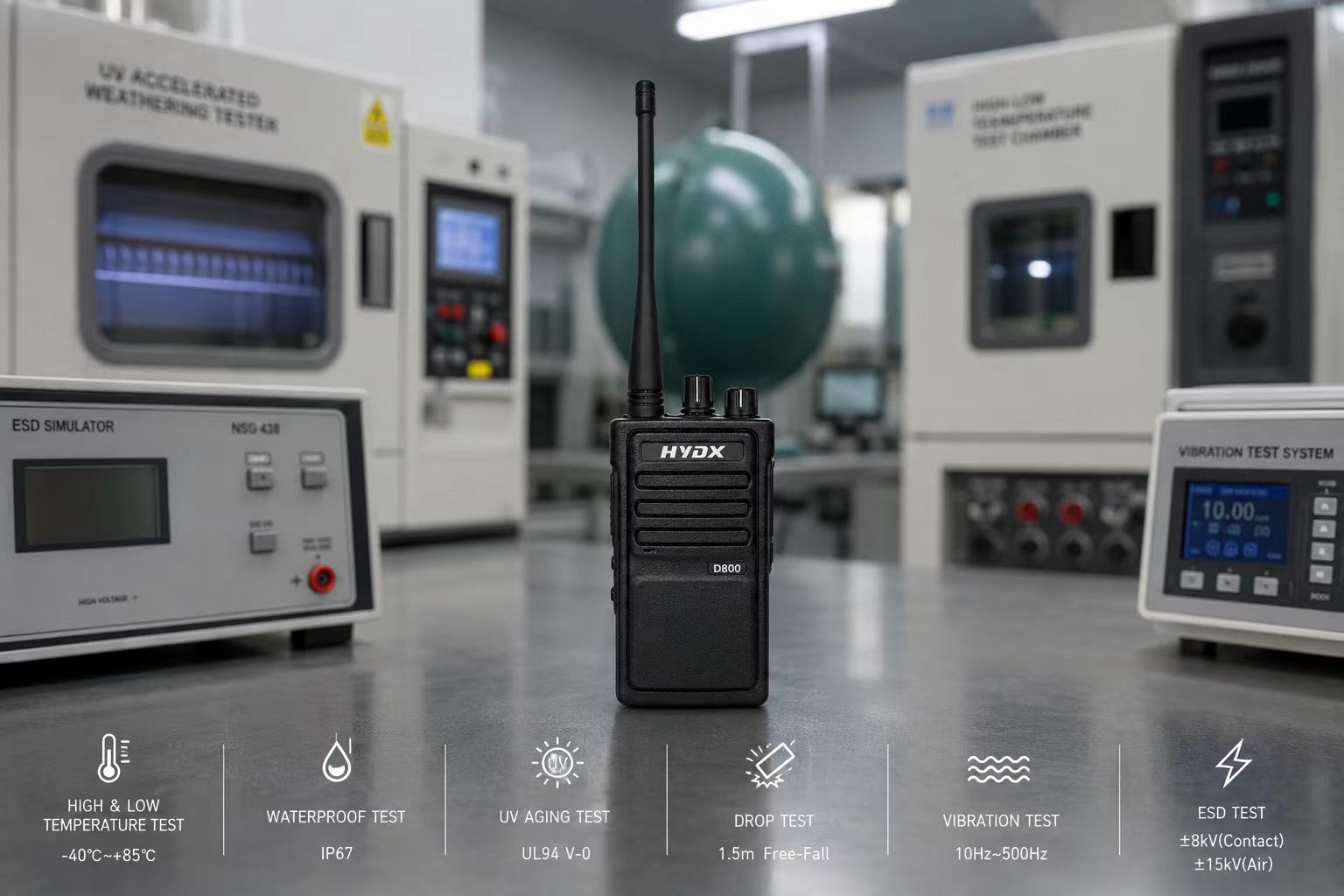
Contact discharge ±8 kV and air discharge ±15 kV per IEC 61000‑4‑2. Performance criterion A (no malfunction) or B (temporary degradation that self‑recovers) must be met.


2.3 Audio Performance
  • Frequency response, total harmonic distortion (THD), signal‑to‑noise ratio (SNR), maximum sound pressure level, and squelch block/release characteristics are measured. All parameters ensure intelligible, feedback‑free voice at controlled sound levels to protect hearing.

3. Environmental Adaptability Tests
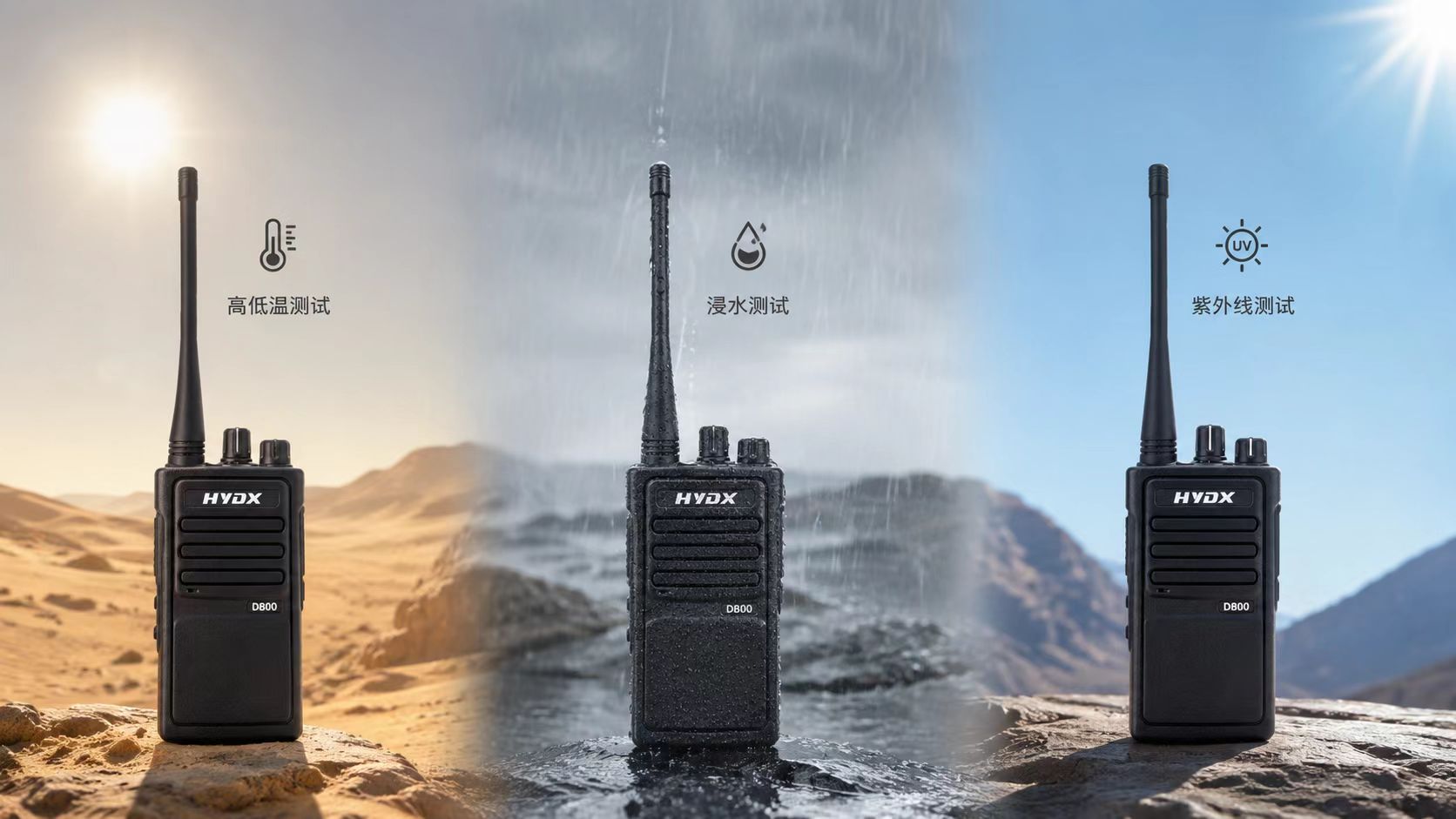
  • Temperature Extremes
Operating tests at –30 °C to +60 °C (minimum 2‑hour soak, temperature change rate ≤3 °C/min to avoid thermal shock) and storage tests at –40 °C to +85 °C. After recovery, all RF parameters and functions are re‑verified; no component damage or performance drift is acceptable.

  • Humidity & Corrosion
– Damp heat: 40 °C / 93 % RH for 48 hours (steady‑state); for severe service, cyclic damp heat (e.g., –10 °C to +55 °C, 95 % RH) may be applied.
– Salt spray: 5 % NaCl at 35 °C for 48 hours (general industrial); marine and fire‑fighting models typically require 96 hours or more. No insulation degradation, pitting, or structural corrosion is permitted.

  • Ingress Protection
IP67 minimum for industrial models—totally dust‑tight and protected against temporary immersion in water (1 m for 30 min). Maritime/fire‑fighting models may call for IPX8 with specified depth and duration (e.g., 2 m for 2 hours).

  • Special Environments
Low‑pressure , solar radiation, and mould growth tests are conducted per relevant national and international standards when operational scenarios demand.

4. Mechanical Reliability Tests
  • Free‑Fall & Tumble
– 1.5 m free‑fall onto concrete, six faces, for all models.
– Tumble test: 200 cycles in a 1 m rotating drum per IEC 60068‑2‑31, simulating repeated drops during field use. No cracks, loose parts, or solder joint failures are acceptable.

  • Vibration & Shock
– Vibration: 10–500 Hz sinusoidal or random, 2 hours per axis (three axes).
– Shock: half‑sine pulse, 30 g / 6 ms for commercial, 75 g / 6 ms for industrial.
– Sampling X‑ray inspection of BGA solder joints and internal connections detects displacement or micro‑cracks.

  • Durability & Lifetime
– PTT switch and rotary controls: >100,000 cycles under electrical load; contact resistance is monitored to detect excessive drift.
– Battery/antenna/audio connectors: >1,000 insertion/removal cycles with contact‑resistance checks.
– Touchscreen: >1 million taps/swipes with function verification.

  • Structural Strength
– Crush and roll‑over resistance tests.
– Enclosure flame retardancy rated UL94 V‑0 to prevent fire propagation.

5. Functional Compliance, Final Inspection & Advanced Validation
  • Full Function Test
Every unit is checked for PTT response, squelch operation, channel switching, encryption/decryption, GPS/BeiDou positioning, Bluetooth connectivity, alarm functions, and accessory detection.

  • Regulatory Verification
RF parameters and model designations are matched against type‑approval certificates (SRRC or CCC for domestic sales; FCC Part 90/95, CE RED, or IC for exports). For explosion‑proof models, intrinsically safe markings, gas group, temperature class, and electrical safety parameters are fully verified against the certified documentation.

  • Batch Sampling & Packaging
Periodic type‑test sampling per national standards includes vibration, drop, and climatic stress on packaged units (e.g., ISTA transport simulations), ensuring packaging integrity under logistics conditions.

  • Optional Advanced Testing
For high‑reliability applications (public safety, military), Highly Accelerated Life Testing (HALT) is often applied during design validation to rapidly uncover design margins. Furthermore, enhanced receiver metrics such as co‑channel rejection, dynamic range, and FM hum and noise (for analogue) may be assessed to fully characterise performance in dense electromagnetic environments.

Each step in this test programme reinforces the promise of uninterrupted communication in critical moments—transforming a small device into a trusted lifeline for emergency response, industrial operations, and outdoor missions.

The actual testing standards will be implemented according to the requirements of the HYDX Laboratory and the customer.

伝言を残す

伝言を残す
当社の製品に興味があり、詳細を知りたい場合は,ここにメッセージを残してください,できるだけ早く返信します.

製品

whatsapp